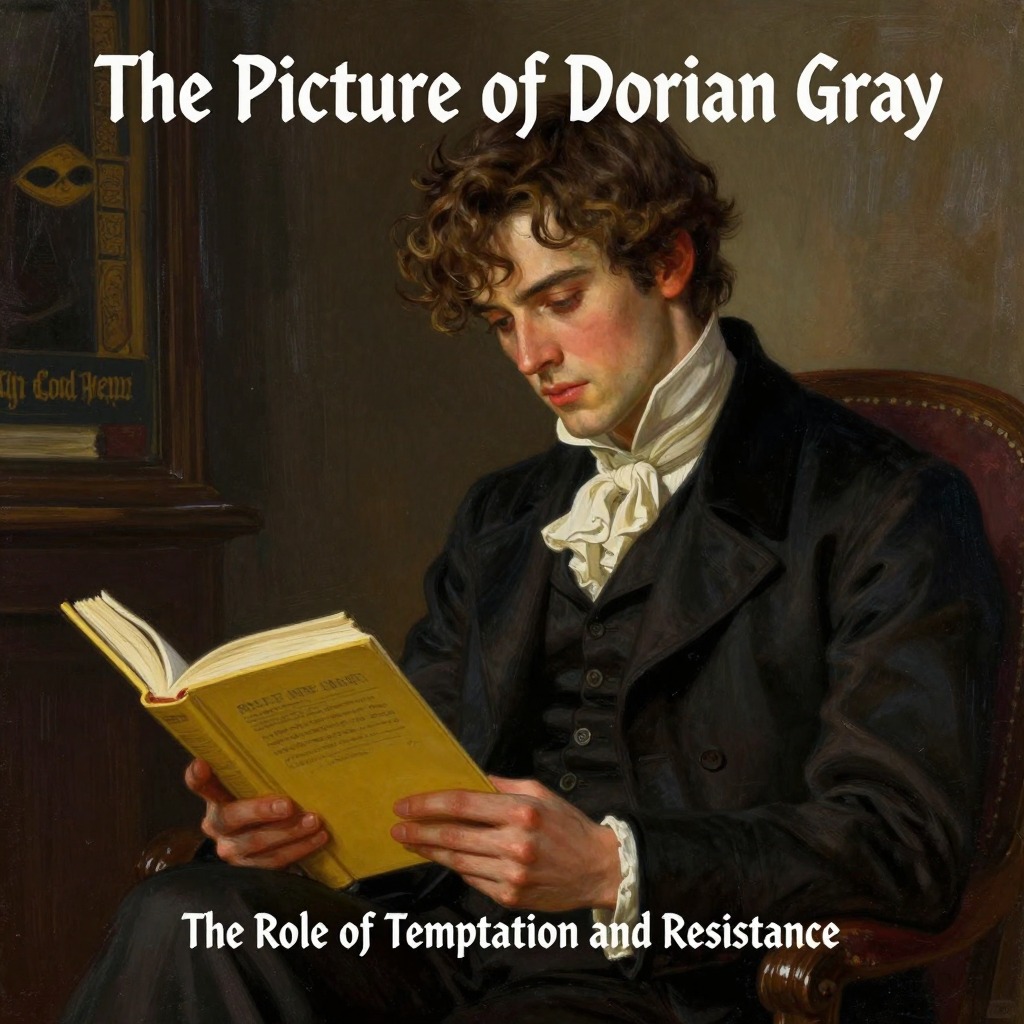
The only way to get rid of a temptation is to yield to it.
Lord Henry Wotton's aphorism, "The only way to get rid of a temptation is to yield to it," is one of the most consequential statements in Oscar Wilde's The Picture of Dorian Gray. Uttered during his first conversation with Dorian Gray in Basil Hallward's garden, the maxim encapsulates the novel's philosophical core: a radical hedonism that rejects self-denial and elevates the pursuit of sensation above moral restraint. The phrase does not merely describe a psychological observation; it functions as a performative utterance that reshapes Dorian's consciousness, setting in motion the chain of events that leads to his corruption, his crimes, and his ultimate destruction.
Origin and Context of the Aphorism
The aphorism emerges in Chapter I, during the pivotal garden scene where Lord Henry first exercises his influence over Dorian. Having already declared that "all influence is immoral" because it gives one's own soul to another, Lord Henry elaborates his philosophy of self-realization. He argues that resisting temptation only makes the soul "grow sick with longing," while yielding to it is a form of purification: "The body sins once, and has done with its sin, for action is a mode of purification." The statement is delivered with Lord Henry's characteristic languid charm, his "low, musical voice" and graceful gestures lending it an almost hypnotic authority. The words strike Dorian with the force of a revelation: "they had touched some secret chord, that had never been touched before, but that he felt was now vibrating and throbbing to curious pulses." The aphorism thus enters Dorian's mind not as an abstract idea but as a lived emotional experience, a "new chaos" created by the terrible power of words.
Immediate Effect on Dorian Gray
The immediate consequence of Lord Henry's words is a profound psychological transformation. Dorian, who had previously been "unspotted from the world," suddenly becomes conscious of his own beauty and its inevitable decay. The aphorism about yielding to temptation dovetails with Lord Henry's panegyric on youth and his warning of its brevity, producing in Dorian a "sharp pang of pain" and a desperate wish that the portrait Basil Hallward has painted might age while he remains young. This wish, uttered in the same scene, becomes the Faustian bargain that governs the rest of the novel. The aphorism thus directly precipitates the magical substitution: Dorian's prayer that the portrait bear the burden of his sins is itself an act of yielding to the temptation of eternal youth, a temptation Lord Henry's words have made irresistible.
The Aphorism as a Guiding Principle
Throughout the novel, Dorian internalizes Lord Henry's maxim as a practical guide to life. After Sibyl Vane's suicide, when he might have felt remorse, he instead rationalizes his cruelty by adopting Lord Henry's aesthetic detachment: "I cannot repeat an emotion. No one can, except sentimentalists." The aphorism about yielding to temptation becomes the foundation of his new hedonism, a philosophy that justifies every indulgence. He pursues "new sensations" with a voracious appetite, studying perfumes, jewels, embroideries, and ecclesiastical vestments, and immersing himself in the "poisonous book" Lord Henry gives him. The portrait, which records the moral cost of each yielded temptation, becomes a secret mirror of his soul, but Dorian continues to yield, finding in each new sin a "terrible joy." The aphorism's logic—that resistance only intensifies desire—provides a seemingly rational justification for his descent into debauchery and crime.
The Aphorism's Culmination in Murder
The most extreme application of the principle occurs when Basil Hallward confronts Dorian about the rumors surrounding his life. Basil, who has come to plead with Dorian to reform, insists that sin writes itself across a man's face and that he wants to see Dorian's soul. Dorian, enraged and terrified, yields to the temptation of violence. He leads Basil to the locked room, reveals the hideously transformed portrait, and then, in a moment of uncontrollable hatred, stabs him to death with a knife. The murder is the ultimate act of yielding to a temptation—the temptation to silence the voice of conscience, to destroy the witness to his shame. The aphorism's logic, taken to its extreme, leads not to purification but to damnation.
The Failure of the Aphorism
In the novel's final chapter, Dorian attempts to break free from the philosophy that has governed his life. He spares Hetty Merton, a village girl, deciding not to corrupt her as he has corrupted so many others. He hopes this "good action" will reverse the portrait's decay, but when he examines the canvas, he finds it more loathsome than before, with a look of cunning and hypocrisy. The aphorism has failed: yielding to temptation has not purified him but has instead made his soul irredeemably hideous. In a final, desperate act, he seizes the knife that killed Basil and stabs the portrait, attempting to destroy the evidence of his sins. The result is his own death: the servants find a withered, wrinkled corpse on the floor, while the portrait is restored to its original youthful beauty. The aphorism's promise of purification through surrender is revealed as a lie; the only way to get rid of the temptation was never to have yielded to it in the first place.